Monday, December 22, 2008
New Bikes: Suzuki Shogun 125RR and 125SP
I know this post is a little bit late. I was thinking whether to include this bike or not on this blog because this blog is mostly about Yamaha cub bikes but I can't resist the temptation given by Shogun 125 SP by Suzuki.
When I was studying in secondary school, my father bought me a Suzuki Best 110. At that time, there were Yamaha SS 110 and RG Sports 110 as the contender to Best 110. So, I think it is also relevant to put it into this blog.
The wow element that I can find in this Shogun is on the installation of front and rear disc brake. Front and rear disc brake is very hard to find fitted on cub bikes. The bikes that I know have this kind of installation is Yamaha 125Z and Suzuki RGX 120 in Malaysia. In Thailand, it is a different story because they have a lot of cub bike fitted with front and rear disc brake like Honda Sonic, Honda Nova, Kawasaki Leostar, Yamaha X1R and many more.
The other good element in this Shogun is the availability of manual hand clutch which gives better acceleration and torque to the bike. The other bike that have manual hand clutch is Yamaha LC135ES only.
The sport rim is also my favourite because it features the Y-spoke. Y-spoke sport rims is used in many popular bike like Aprilia RS125 and Kawasaki Ninja ZX250R. Both which are also my favourite bike other than Yamaha.
The downside of this bike is the use of old style rear suspension which is still NOT monoshock. This make the overall looks of the bike look safe and nothing special. You can modified your LC135 to get front and rear disc brake, but it is much much harder to change the double shock system to monoshock system. One more thing is about the displacement(cc) of the Shogun. It is only 125cc where nowadays the buzzword is 135cc. I really think Suzuki need to do something about it.
For more information, head up to here.
Shogun 125 RR (Clutch auto) RM5,253.75
Shogun 125 SP (Clutch manual) RM5,400.25
via : motomalaya.blogspot.com
Saturday, December 13, 2008
The Suzuki SV1000S, Good Secondhand Choice
The Suzuki SV1000S is a superb new or secondhand motorcycle choice, the 1000cc V-twin engine is placed in a simple roadster chassis with a frame-mounted half fairing and fully adjustable suspension motorcycle. The Suzuki SV1000S is easy to ride, also very good on the power side and comfort – but somehow just a little bland, which is probably why it never sold in large numbers worldwide. Still the Suzuki SV1000S can be bought relatively cheap compared to what it offers.The Suzuki SV1000S look similar to the Suzuki SV650, but with twin exhaust pipes. Stock one are quiet but they're easy to replace and replacement can increase the horses pulling this motorcycle.
The liquid-cooled, 4 valve DOHC per cylinder, four-stroke 1000cc V-twin engine is the same as in the Suzuki V-Strom DL1000 big trail style motorcycle. It's then no surprise that the SV1000S engine produces about 120 horsepower.
In the early days of this engine the biggest glitch was a incorrectly machined crank on some earlier models, which caused a horrible knocking sound. But then it was just a sound and nothing was actually going to break.
Riding the Suzuki SV1000S is a pleasure, the handling of the Suzuki SV1000S is excellent, cornering is very easy. Comparing the SV1000S with its smaller brother we have to conclude that the SV1000S is actually easier in the corners then the Suzuki SV650. The suspension of the Suzuki SV1000S isn't the best but it is fully adjustable. It's worth experimenting with it if you're not happy with the handling. Adjusting the suspension can make a huge difference to the riding pleasure.
copy from : http://www.motorcycle.in.th
The Yamaha XJ6, the cool new middleweight
2009 sees an addition to Yamaha’s middleweight collection in the dynamic new Yamaha XJ6, the naked version of the 2009 Yamaha XJ6 Diversion with a character all of its own. This striking all-new 600 with its lightweight new chassis, stylish bodywork and low seat height is ideal for both new and experienced riders looking for a beautifully-designed performance middleweight.Technically the Yamaha XJ6 shares the same bases as the Yamaha XJ6 Diversion, but with a contemporary and agile roadster look. Its newly-developed four cylinder engine and responsive torque makes this The cool all-rounder – whether you’re on the motorway, in town or on twisting back roads this bike has a consistency of performance to delivery a truly special ride every time.
Complementing the wardrobe of the Yamaha XJ6 are several new accessories for an extra practical touch or hint of individualism. A rear carrier complete with top-case stands alongside a flip-up screen and a new range of soft and durable luggage bags. The Yamaha XJ6 engine guards, among other items in the spectrum of add-ons, show the high degree of quality, design and style typical of all products leaving Yamaha’s factory floors.
The Yamaha XJ6 is powered by a 600cc liquid-cooled 4-stroke inline 4-cylinder engine with all-new internals, this cool-looking middleweight delivers easy controllability together with strong all-round performance. A newly designed easy-action clutch makes for smooth gear shifting, and the stylish 4-1 exhaust and compact midship muffler give this new 600 a seriously sporty image. The combination of a lightweight tubular diamond-type frame together with 41mm front forks and an efficient Monocross rear suspension system ensure agile handling performance in the city, through mountain passes and out on the highway. A low seat height enhances overall controllability at low speeds – and ABS available as an option.
copy from : http://www.motorcycle.in.th
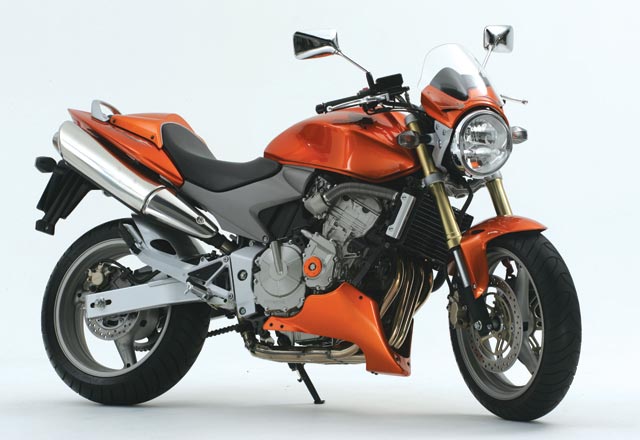
Secondhand Honda CB600F Hornet, Toughest Bike
The engine from the old model Honda CBR600 sportbike, detuned via smaller carburetors for more midrange, in a new steel backbone frame but with wide, flat bars and no fairing. It has budget clocks and basic specifications. Early models had a 16 inch front wheel this was later switched for a 17 inch. A 5mm increase in the wheelbase tamed the Honda Hornet's manic nature a little. Later on there was a half-faired option. The Honda Hornet was revamped in 2003.Early models of the Honda Hornet CB600F can be twitchy. The engine's great, but the 16 inch front wheel and bouncy suspension can make it a handful on bumpy roads, though the wide bars help you keep it pointing in the right direction. Fuel efficiency and poor range spoil the picture 12.5km/l. And 145km to reserve is typical, so don't try touring on a Honda Hornet CB600F. And forget throw-over panniers with that high-level exhaust. In late 1999 it got a 17 inch front wheel to improve handling, with a 120 section tyre in 2000 to sweeten the steering.
For the people thinking about quality of the Honda CB600F. This is one of the toughest motorcycles ever built – and it's detuned to boot. Keep the oil changed and it won't break. The one weakish spot is the camchain tensioner, which may stick – listen for a rattle on start-up that goes away as the engine warms. Unbolting the tensioner unit from the back of the block and fitting a new one is a 15-minute job and the unit costs not that much. Enthusiastic wheelie merchants might break second gear and will certainly nadger the steering head bearings, but that's it.
The Honda CB600F Hornet is somewhat of a cult bike, so holds its value quite well. Yamaha's old-model FZS600 Fazer is the obvious rival: similar performance, better economy and range, excellent throttle response, comes with a centrestand and top fairing but without the Honda Hornet's lunatic edge.
copy from : http://www.motorcycle.in.th
The Tiger Boxer 250 RS, the Thai All-Rounder bike
The Tiger Boxer 250 RS all-rounder. Now there's a whishy-washy term. Giving motorcycles labels – sportbike, tourer, cruiser – gives us a mental picture of what we're getting. But the 'all-rounder' badge often suggest a bland compromise that's neither nowt nor summat.Or it used to. Recently the all-rounders have become leaner and more capable. In Thailand the all-rounder bikes come from Tiger Motorcycle, which manufactures the Tiger Boxer 200 R and the Tiger Boxer 250 RS they offer genuine all-day comfort, practicality and ease of use in packages that can also excite.
Tiger Motorcycle's new Tiger Boxer 250 RS follows the trend for taller, more upright all-rounders. It's based on a perky 250cc single cylinder engine, slim flanks, low weight and firm suspension. It has a roomy riding position and ample pillion space to keep it useable. It even has optional hard luggage.
Looking at the Tiger Boxer 250 RS, with its sporty looks, newly designed aluminum swingarm and inverted front forks, it is hard to belief that this motorcycle has no competition on the Thai motorcycle market. The closest rival would be the Kawasaki Nina 250R, but the Kawasaki is more a sportbike, and cost twice as much so the Tiger Boxer 250 RS should be just what you need. That's the theory, anyway. Dicing with traffic, pedestrians and urban chaos is demanding and the Tiger Boxer 250 RS rules in the city, while offering enough power and riding comfort to do some out-of-town touring.
The Tiger Boxer 250 RS shines at his job as all-rounder bike, particularly the engine. The engine can rev remarkable easy, without being to revvy in nature, the 250cc single cylinder give a smooth surge between 6000 to 8500rpm that's perfect at real road speeds.
The Tiger boxer 250 chassis has a similar undemanding character. A light feel and ample leverage from the handlebars gives easy, prompt direction changes – picking off traffic and slipping through congestion is a breeze, especially from the elevated upright riding position.
copy from : http://www.motorcycle.in.th
Friday, December 12, 2008
Honda Acura TL 2009

The new honda 2009 Acura TL moves further upmarket with a more aggressive interpretation of Acura's latest styling vocabulary, known as "Keen Edge Dynamic." The size of the car has increased slightly as a consequence, and the wheelbase has been stretched 1.4 inches to 109.3 inches. The car is also 6.2 inches longer overall, 1.8 inches wider and 0.5 inch taller. Rear legroom improves by 1.3 inches and rear shoulder room increases by 0.5 inch. The all-new package also improves structural rigidity significantly, thanks in part to the use of high-strength steel in 47.6 percent of the chassis.
The standard TL will be front-wheel drive and is powered by a 3.5-liter V6 that makes 280 hp and 254 pound-feet of torque, an increase of 22 hp and 21 lb-ft over the previous 3.2-liter V6. The new TL SH-AWD ("Super-Handling All-Wheel Drive") replaces the previous TL Type-S and is powered by a 3.7-liter V6 that produces 305 hp and 275 lbs-ft, an increase of 19 hp and 19 lb-ft over the 3.5-liter V6 of the Type-S. A five-speed automatic transmission is standard equipment for both engines and features shift paddles on the steering wheel.
The chassis features double-wishbone front suspension and multilink rear suspension. Electric power steering is standard for both models. The TL rides on 245/50R17 tires, the TL SH-AWD has 245/45R18 tires and 245/40ZR19 summer performance tires are optional for the TL SH-AWD.
As before, the 2009 Acura TL continues to provide an extensive list of electronic convenience items, now including a central multifunction display, an eight-speaker audio system with a six-disc CD changer, XM Satellite Radio and USB port connectivity. An Acura/ELS audio system with 10 speakers, surround-sound and DVD-A compatibility is available.
Honda Acura TL 2009

The new honda 2009 Acura TL moves further upmarket with a more aggressive interpretation of Acura's latest styling vocabulary, known as "Keen Edge Dynamic." The size of the car has increased slightly as a consequence, and the wheelbase has been stretched 1.4 inches to 109.3 inches. The car is also 6.2 inches longer overall, 1.8 inches wider and 0.5 inch taller. Rear legroom improves by 1.3 inches and rear shoulder room increases by 0.5 inch. The all-new package also improves structural rigidity significantly, thanks in part to the use of high-strength steel in 47.6 percent of the chassis.
The standard TL will be front-wheel drive and is powered by a 3.5-liter V6 that makes 280 hp and 254 pound-feet of torque, an increase of 22 hp and 21 lb-ft over the previous 3.2-liter V6. The new TL SH-AWD ("Super-Handling All-Wheel Drive") replaces the previous TL Type-S and is powered by a 3.7-liter V6 that produces 305 hp and 275 lbs-ft, an increase of 19 hp and 19 lb-ft over the 3.5-liter V6 of the Type-S. A five-speed automatic transmission is standard equipment for both engines and features shift paddles on the steering wheel.
The chassis features double-wishbone front suspension and multilink rear suspension. Electric power steering is standard for both models. The TL rides on 245/50R17 tires, the TL SH-AWD has 245/45R18 tires and 245/40ZR19 summer performance tires are optional for the TL SH-AWD.
As before, the 2009 Acura TL continues to provide an extensive list of electronic convenience items, now including a central multifunction display, an eight-speaker audio system with a six-disc CD changer, XM Satellite Radio and USB port connectivity. An Acura/ELS audio system with 10 speakers, surround-sound and DVD-A compatibility is available.
Honda Freed
2.87 in × 3.52 in
Cylinders S-4
Displacement 1.5 litre
1496 cc
(91.292 cu in)
Type SOHC
Key:
SOHC
Single overhead camshaft
DOHC
Double overhead camshaft
OHV
Overhead valves
TS
Two stroke
SV
Side valves
Sl
Sleeve valves
oise
Overhead inlet side exhaust
See more...
4 valves per cylinder
16 valves in total
Construction
Sump Wet sumped
Compression ratio 10.40:1
Fuel system Honda PGM-FI fuel injection
Maximum power
(JIS net) 117.6 PS (116.0 bhp) (86.5 kW)
@ 6600 rpm
Specific output 77.5 bhp/litre
1.27 bhp/cu in
Maximum torque
(JIS net) 144.0 Nm (106 ft·lb) (14.7 kgm)
@ 4800 rpm
bmep 1209.6 kPa (175.4 psi)
Specific torque 96.26 Nm/litre
Maximum rpm
Manufacturer Honda
Code L15A
Main bearings
Coolant Water
Bore/stroke ratio 0.82
Unitary capacity 374 cc/cylinder
Aspiration Normal
Compressor type N/A
Intercooler None
Catalytic converter Y

| Wheelbase | 2740 mm | 107.9 in | ||
|---|---|---|---|---|
| Track | front | 1480 mm | 58.3 in | |
| rear | 1465 mm | 57.7 in | ||
| Length | 4215 mm | 165.9 in | ||
| Width | 1695 mm | 66.7 in | ||
| Height | 1715 mm | 67.5 in | ||
| Length:wheelbase ratio | 1.54 | |||
| Ground clearance | 150 mm | 5.9 in | ||
| Kerb weight | 1270 kg | 2800 lb | ||
| Weight distribution (Front) | ||||
| Fuel capacity | 42 litres | 9.2 UK Gal | 11.1 US Gal | |
Honda Freed
2.87 in × 3.52 in
Cylinders S-4
Displacement 1.5 litre
1496 cc
(91.292 cu in)
Type SOHC
Key:
SOHC
Single overhead camshaft
DOHC
Double overhead camshaft
OHV
Overhead valves
TS
Two stroke
SV
Side valves
Sl
Sleeve valves
oise
Overhead inlet side exhaust
See more...
4 valves per cylinder
16 valves in total
Construction
Sump Wet sumped
Compression ratio 10.40:1
Fuel system Honda PGM-FI fuel injection
Maximum power
(JIS net) 117.6 PS (116.0 bhp) (86.5 kW)
@ 6600 rpm
Specific output 77.5 bhp/litre
1.27 bhp/cu in
Maximum torque
(JIS net) 144.0 Nm (106 ft·lb) (14.7 kgm)
@ 4800 rpm
bmep 1209.6 kPa (175.4 psi)
Specific torque 96.26 Nm/litre
Maximum rpm
Manufacturer Honda
Code L15A
Main bearings
Coolant Water
Bore/stroke ratio 0.82
Unitary capacity 374 cc/cylinder
Aspiration Normal
Compressor type N/A
Intercooler None
Catalytic converter Y

| Wheelbase | 2740 mm | 107.9 in | ||
|---|---|---|---|---|
| Track | front | 1480 mm | 58.3 in | |
| rear | 1465 mm | 57.7 in | ||
| Length | 4215 mm | 165.9 in | ||
| Width | 1695 mm | 66.7 in | ||
| Height | 1715 mm | 67.5 in | ||
| Length:wheelbase ratio | 1.54 | |||
| Ground clearance | 150 mm | 5.9 in | ||
| Kerb weight | 1270 kg | 2800 lb | ||
| Weight distribution (Front) | ||||
| Fuel capacity | 42 litres | 9.2 UK Gal | 11.1 US Gal | |
2009 Honda Civic Hybrid vs. 2009 Honda Fit Sport

They're not fast, they don't corner hard and they're certainly not the most pulse-quickening cars we've ever tested at Inside Line. But if fuel-efficiency and utility are priority items in your next car purchase, then the 2009 Honda Civic Hybrid and 2009 Honda Fit Sport are unbelievable machines.
Combining economic operation and utility like few other cars sold today, either of these Hondas is a responsible choice for the buyer looking to save fuel, minimize emissions and haul the family. Each has its own unique qualities — important distinctions that can't be overlooked.
The question, then, is which is the better car? To figure it out, for two weeks we used the 2009 Honda Civic Hybrid and the 2009 Honda Fit as they're designed to be used. We drove them to work, loaded our families in them, packed our groceries in them and took them to the track to measure their performance. We argued the merits of the Civic's superb fuel economy vs. the Fit's exceptional utility.
In doing so, we designed this test to suit the priorities of a buyer looking for reasonably priced utilitarian transportation. Accordingly, fuel economy and price make up the majority of each car's total score at 25 percent each. Performance, feature content and our 29-point evaluation score make up 15 percent each, while editors' personal and recommended picks combine for the remaining 5 percent.
The Distinctions
Both our test cars represent the very top of their respective model lines. In other words, you can't buy a more expensive Fit or Civic.
Our 2009 Honda Fit Sport test car included the new-for-2009 five-speed automatic transmission, which complements the Fit's 1.5-liter inline-4 engine rated at 117 horsepower and 106 pound-feet of torque. Including Honda's voice-recognition navigation system brings the Fit Sport's cost to $19,430 including destination.
The hybrid powertrain isn't the only feature jacking up the Civic's price. This car also has been equipped with a navigation system and leather seats, which pushed its sticker (including destination) to $27,420 — nearly an $8,000 premium beyond the Fit Sport. The combined power rating of its 1.3-liter, inline-4 gasoline engine and 20-kilowatt electric motor is 110 hp and 123 lb-ft of torque. A continuously variable transmission puts power to the ground.
If it's air emissions you're concerned with, the Civic is EPA-certified as a Tier 2, Bin 2 polluter, while the Fit earns a Tier 2, Bin 5 rating. The California Air Resources Board (CARB) classifies the Civic as an AT-PZEV and the Fit as a ULEV2. In case you're not familiar with the alphabet soup of emissions ratings, this means that the Civic emits roughly as many pollutants while running for a week as a 1976 Chevy Beauville Van does leaking oil in your driveway for a day. And the Fit emits only a little more.
Both cars are fitted with front, side and curtain airbags; stability control; and antilock brakes.
Living With Them
Unlike the Toyota Prius, the 2009 Honda Civic Hybrid manages to look and act like a normal car. There's a conventional key to start the engine, and a conventional shifter. Short of its goofy wheels, there's very little giveaway visually that this is a hybrid. Start driving, however, and it's clear this is no normal car. Its electric-assisted power steering lacks the feel and response of a conventional Civic and it quickly becomes obvious that handling hasn't been a priority in the tuning of its chassis. If, like most hybrid owners, you're not one to be engaged by the way a car feels when you drive it, then there's little here to dislike.
Here's something funny. Jump out of a Civic Hybrid and into a Fit and you'll swear you're driving a sports car — even with the automatic tranny. The Fit's shift paddles on the steering wheel allow you to downshift for a corner and exercise precise control over engine braking — the Civic can't manage either of these tasks. There's better steering feel, a more responsive powertrain and relatively engaging handling in the Fit as well. Bottom line: It's a hell of a lot more fun.
But your extra money does get you more than a hybrid powertrain in the Civic. Its leather-upholstered seats and automatic climate control are worthwhile amenities that aren't available in the Fit. Plus, it's a just a nicer car, without the noticeable evidence of cost-cutting that's easy to find in the Fit.
Reality
The truth is, if you're willing to overlook the Civic's awkward control feel and miserably slow acceleration, both of these cars will serve you well for daily commuting and family hauling, which is really what they're for.
But you don't have to look far to realize how much more practical the 2009 Honda Fit is when it comes to moving cargo. Even with its rear seats in the upright position, it offers almost twice as much cargo space as the Civic (20.6 cubic feet vs. 10.4 cubic feet). Fold those seats flat and cargo volume expands to a massive 57.3 cubic feet. Plus, the Civic simply can't compete with the Fit's flexibility when it comes to configuring the cargo area.
With the ability to raise its split-folding seat bottoms against their seatbacks, the Fit is unmatched in this aspect of utility. The Civic, meanwhile, lacks even a simple pass-through into the trunk because its battery pack is in the way.
Fuel Consumption
We measured fuel economy using two sets of criteria. First, we performed a test in which both cars were driven twice in controlled conditions — one highway route totaling 83 miles and two city loops totaling 180 miles. Driving the cars together and using the same driving style and similar speeds ensured equal conditions for both cars. Air-conditioning was used during city testing and one driver refueled both cars at the same pump using the same fill technique.
We use the EPA's combined fuel economy number for fuel economy scoring in this test, but offer our own test results to demonstrate how each car performed in various conditions with our editors behind the wheel.
Not surprisingly, the 2009 Honda Civic Hybrid easily won every fuel consumption test. It earned an average of 45.7 mpg in our controlled tests — 48.7 mpg in the city and 40.4 mpg on the highway. The Fit, however, was still respectable. It produced a 32.8 mpg average — 32.9 mpg city and 32.7 mpg highway.
Second, we calculated observed fuel economy over our entire time with each car, just as we do in all our comparison tests. Though this data isn't gathered in controlled conditions, it provides a useful idea of the fuel economy each car is likely to produce in the hands of the average driver during everyday driving. The Civic Hybrid again proved superior by squeezing an impressive 36.1 miles from every gallon of fuel. The Fit averaged 29.2 mpg in everyday use.
At the Track
There's no question that both these cars are more impressive when it comes to saving fuel than they are when it comes to conquering a drag strip. Still, even fuel misers like these are expected to operate in environments that require quick acceleration and reasonable agility, so our track tests are telling.
The 2009 Honda Fit ruled our performance tests like Garry Kasparov would dominate Jenny McCarthy in a chess match. Its 11.0-second 0-60 time (10.7 seconds with 1 foot of rollout like on a drag strip) might seem slow until you notice that 13.5 seconds (13.1 seconds with 1 foot of rollout like on a drag strip) are required for the Civic Hybrid to achieve the same velocity. The story is the same in the quarter-mile, where the Fit's 17.9-second pass at 75.7 mph embarrasses the Civic's effort of 19.3 seconds at 72.5 mph.
The story that those numbers don't tell is the influence a 19-second quarter-mile time has on your driving style. Truth is, this is slow enough that it requires some compensation when you're merging onto freeways. Mostly, this just means being patient — something most drivers in Los Angeles have long since forgotten. We found the Civic's acceleration too slow in many instances. Even when we were patient, others weren't.
Despite its beam-type rear suspension, the Fit showed the independently suspended Civic its taillights in our handling tests. Clearly, this is a tuning issue, since the Civic's platform is fundamentally superior. The Fit pushed through the slalom at 67.8 mph vs. the Civic's 64.1-mph pass. Lateral grip, too, proves to be in the Fit's favor at 0.77g vs. the Civic's 0.72g performance.
The Fit's 134-foot stopping performance from 60 mph won't break any records, but it is 6 feet shorter than the Civic's 140 feet. As with most hybrids, the Civic's brake feel proves awkward and lacks consistency because of the problematic transition from regenerative braking to mechanical braking.
Cost vs. Benefit
Here's the real rub with most hybrids. In most cases, the added cost of the hybrid powertrain makes them prohibitively expensive relative to their conventional rivals. This is exactly the case here.
Sure, the Civic is more fuel-efficient. Using our combined fuel economy figures (36.1 mpg Civic/29.2 mpg Fit) and a rate of 15,000 miles of annual driving, it's clear that the Civic Hybrid will consume 98 gallons of fuel fewer than the Fit in one year. But once you calculate the current average U.S. fuel cost, it's clear that it will take almost 26 years to make up the price difference between the two cars with the savings in fuel costs alone. That's a hard sell for any hybrid.
Another consideration with any hybrid is the cost of replacing its batteries. We don't see this as a big risk with the Civic, since Honda stands behind the hybrid components with a standard eight-year/80,000-mile warranty, which, in states following California emissions standards, will extend to 10 years or 150,000 miles. Even so, replacing the batteries will cost about $2,000.
The 2009 Honda Fit wins this comparison test primarily because it offers 80 percent of the 2009 Honda Civic Hybrid's fuel economy at 70 percent of its cost. The Fit also happens to provide equal passenger space, far more cargo capacity and much better flexibility in the kind of cargo it will carry. In a game of fuel consumption and utility, the 2009 Honda Fit is the obvious choice. And while it might not quicken your pulse like some cars we test, it has a rare combination of efficiency and function that easily beats the Civic.
The manufacturers provided Edmunds these vehicles for the purposes of evaluation.
2009 Honda Civic Hybrid vs. 2009 Honda Fit Sport

They're not fast, they don't corner hard and they're certainly not the most pulse-quickening cars we've ever tested at Inside Line. But if fuel-efficiency and utility are priority items in your next car purchase, then the 2009 Honda Civic Hybrid and 2009 Honda Fit Sport are unbelievable machines.
Combining economic operation and utility like few other cars sold today, either of these Hondas is a responsible choice for the buyer looking to save fuel, minimize emissions and haul the family. Each has its own unique qualities — important distinctions that can't be overlooked.
The question, then, is which is the better car? To figure it out, for two weeks we used the 2009 Honda Civic Hybrid and the 2009 Honda Fit as they're designed to be used. We drove them to work, loaded our families in them, packed our groceries in them and took them to the track to measure their performance. We argued the merits of the Civic's superb fuel economy vs. the Fit's exceptional utility.
In doing so, we designed this test to suit the priorities of a buyer looking for reasonably priced utilitarian transportation. Accordingly, fuel economy and price make up the majority of each car's total score at 25 percent each. Performance, feature content and our 29-point evaluation score make up 15 percent each, while editors' personal and recommended picks combine for the remaining 5 percent.
The Distinctions
Both our test cars represent the very top of their respective model lines. In other words, you can't buy a more expensive Fit or Civic.
Our 2009 Honda Fit Sport test car included the new-for-2009 five-speed automatic transmission, which complements the Fit's 1.5-liter inline-4 engine rated at 117 horsepower and 106 pound-feet of torque. Including Honda's voice-recognition navigation system brings the Fit Sport's cost to $19,430 including destination.
The hybrid powertrain isn't the only feature jacking up the Civic's price. This car also has been equipped with a navigation system and leather seats, which pushed its sticker (including destination) to $27,420 — nearly an $8,000 premium beyond the Fit Sport. The combined power rating of its 1.3-liter, inline-4 gasoline engine and 20-kilowatt electric motor is 110 hp and 123 lb-ft of torque. A continuously variable transmission puts power to the ground.
If it's air emissions you're concerned with, the Civic is EPA-certified as a Tier 2, Bin 2 polluter, while the Fit earns a Tier 2, Bin 5 rating. The California Air Resources Board (CARB) classifies the Civic as an AT-PZEV and the Fit as a ULEV2. In case you're not familiar with the alphabet soup of emissions ratings, this means that the Civic emits roughly as many pollutants while running for a week as a 1976 Chevy Beauville Van does leaking oil in your driveway for a day. And the Fit emits only a little more.
Both cars are fitted with front, side and curtain airbags; stability control; and antilock brakes.
Living With Them
Unlike the Toyota Prius, the 2009 Honda Civic Hybrid manages to look and act like a normal car. There's a conventional key to start the engine, and a conventional shifter. Short of its goofy wheels, there's very little giveaway visually that this is a hybrid. Start driving, however, and it's clear this is no normal car. Its electric-assisted power steering lacks the feel and response of a conventional Civic and it quickly becomes obvious that handling hasn't been a priority in the tuning of its chassis. If, like most hybrid owners, you're not one to be engaged by the way a car feels when you drive it, then there's little here to dislike.
Here's something funny. Jump out of a Civic Hybrid and into a Fit and you'll swear you're driving a sports car — even with the automatic tranny. The Fit's shift paddles on the steering wheel allow you to downshift for a corner and exercise precise control over engine braking — the Civic can't manage either of these tasks. There's better steering feel, a more responsive powertrain and relatively engaging handling in the Fit as well. Bottom line: It's a hell of a lot more fun.
But your extra money does get you more than a hybrid powertrain in the Civic. Its leather-upholstered seats and automatic climate control are worthwhile amenities that aren't available in the Fit. Plus, it's a just a nicer car, without the noticeable evidence of cost-cutting that's easy to find in the Fit.
Reality
The truth is, if you're willing to overlook the Civic's awkward control feel and miserably slow acceleration, both of these cars will serve you well for daily commuting and family hauling, which is really what they're for.
But you don't have to look far to realize how much more practical the 2009 Honda Fit is when it comes to moving cargo. Even with its rear seats in the upright position, it offers almost twice as much cargo space as the Civic (20.6 cubic feet vs. 10.4 cubic feet). Fold those seats flat and cargo volume expands to a massive 57.3 cubic feet. Plus, the Civic simply can't compete with the Fit's flexibility when it comes to configuring the cargo area.
With the ability to raise its split-folding seat bottoms against their seatbacks, the Fit is unmatched in this aspect of utility. The Civic, meanwhile, lacks even a simple pass-through into the trunk because its battery pack is in the way.
Fuel Consumption
We measured fuel economy using two sets of criteria. First, we performed a test in which both cars were driven twice in controlled conditions — one highway route totaling 83 miles and two city loops totaling 180 miles. Driving the cars together and using the same driving style and similar speeds ensured equal conditions for both cars. Air-conditioning was used during city testing and one driver refueled both cars at the same pump using the same fill technique.
We use the EPA's combined fuel economy number for fuel economy scoring in this test, but offer our own test results to demonstrate how each car performed in various conditions with our editors behind the wheel.
Not surprisingly, the 2009 Honda Civic Hybrid easily won every fuel consumption test. It earned an average of 45.7 mpg in our controlled tests — 48.7 mpg in the city and 40.4 mpg on the highway. The Fit, however, was still respectable. It produced a 32.8 mpg average — 32.9 mpg city and 32.7 mpg highway.
Second, we calculated observed fuel economy over our entire time with each car, just as we do in all our comparison tests. Though this data isn't gathered in controlled conditions, it provides a useful idea of the fuel economy each car is likely to produce in the hands of the average driver during everyday driving. The Civic Hybrid again proved superior by squeezing an impressive 36.1 miles from every gallon of fuel. The Fit averaged 29.2 mpg in everyday use.
At the Track
There's no question that both these cars are more impressive when it comes to saving fuel than they are when it comes to conquering a drag strip. Still, even fuel misers like these are expected to operate in environments that require quick acceleration and reasonable agility, so our track tests are telling.
The 2009 Honda Fit ruled our performance tests like Garry Kasparov would dominate Jenny McCarthy in a chess match. Its 11.0-second 0-60 time (10.7 seconds with 1 foot of rollout like on a drag strip) might seem slow until you notice that 13.5 seconds (13.1 seconds with 1 foot of rollout like on a drag strip) are required for the Civic Hybrid to achieve the same velocity. The story is the same in the quarter-mile, where the Fit's 17.9-second pass at 75.7 mph embarrasses the Civic's effort of 19.3 seconds at 72.5 mph.
The story that those numbers don't tell is the influence a 19-second quarter-mile time has on your driving style. Truth is, this is slow enough that it requires some compensation when you're merging onto freeways. Mostly, this just means being patient — something most drivers in Los Angeles have long since forgotten. We found the Civic's acceleration too slow in many instances. Even when we were patient, others weren't.
Despite its beam-type rear suspension, the Fit showed the independently suspended Civic its taillights in our handling tests. Clearly, this is a tuning issue, since the Civic's platform is fundamentally superior. The Fit pushed through the slalom at 67.8 mph vs. the Civic's 64.1-mph pass. Lateral grip, too, proves to be in the Fit's favor at 0.77g vs. the Civic's 0.72g performance.
The Fit's 134-foot stopping performance from 60 mph won't break any records, but it is 6 feet shorter than the Civic's 140 feet. As with most hybrids, the Civic's brake feel proves awkward and lacks consistency because of the problematic transition from regenerative braking to mechanical braking.
Cost vs. Benefit
Here's the real rub with most hybrids. In most cases, the added cost of the hybrid powertrain makes them prohibitively expensive relative to their conventional rivals. This is exactly the case here.
Sure, the Civic is more fuel-efficient. Using our combined fuel economy figures (36.1 mpg Civic/29.2 mpg Fit) and a rate of 15,000 miles of annual driving, it's clear that the Civic Hybrid will consume 98 gallons of fuel fewer than the Fit in one year. But once you calculate the current average U.S. fuel cost, it's clear that it will take almost 26 years to make up the price difference between the two cars with the savings in fuel costs alone. That's a hard sell for any hybrid.
Another consideration with any hybrid is the cost of replacing its batteries. We don't see this as a big risk with the Civic, since Honda stands behind the hybrid components with a standard eight-year/80,000-mile warranty, which, in states following California emissions standards, will extend to 10 years or 150,000 miles. Even so, replacing the batteries will cost about $2,000.
The 2009 Honda Fit wins this comparison test primarily because it offers 80 percent of the 2009 Honda Civic Hybrid's fuel economy at 70 percent of its cost. The Fit also happens to provide equal passenger space, far more cargo capacity and much better flexibility in the kind of cargo it will carry. In a game of fuel consumption and utility, the 2009 Honda Fit is the obvious choice. And while it might not quicken your pulse like some cars we test, it has a rare combination of efficiency and function that easily beats the Civic.
The manufacturers provided Edmunds these vehicles for the purposes of evaluation.
New Honda 2009

- Motor Sport bermesin tegak150cc DOHC, dengan liquid cooled. Basic CBR 150RR, tetapi naga-naganya dengan desain baru yang lebih sporty, eksotik, dan lebih modern. Karena model CBR 150RR ini sudah berbagi image dengan Minerva si “saudara tirinya”. Basic manufacturing machine untuk engine product ini sudah ada dari CS-1.
- Bebek Sport (bebek jago) bermesin tegak 125cc SOHC, dengan sistem pendingin liquid cooled. basic mesin dan rangka sama dengan CS-1. Disinyalir turunan langsung dari NOVA SONIC 125RR. Nah kurang apalagi, sekarang saatnya agreesi tahap 2 untuk menggulung Yamaha Jupiter MX sekaligus menghancurkan Suzuki Satria FU-150. (CS-1, hanya study case - test, sekaligus merupakan flangking strategy Honda untuk pijakan strategy selanjutnya di kategori kelas bebek sport 125cc up.
- Bebek Comuter 110cc, (adiknya Blade yang baru dilauching ini). Mesin horisontal 110cc SOHC, sistem pendinginan sirip udara, vacum karburator. Product ini akan sekelas dengan Yamaha Vega ZR 115cc yang akan segera di Lauching oleh YMKI. Varian ini sekaligus sebagai lower segment, lower model dan lower price dari Honda Blade 110R. Diprediksi hanya akan memiliki varian velg spoke meniru strategy YMKI pada Jupiter Z vs Vega R. (Blade 110R hanya memiliki varian velg CW).
- Matic Premium (varian AirBlade ver.Thailand). Nah Honda sudah punya Vario di segment medium matic, baru-baru ini ada Beat di Low price segment. Jikalau ingin menguasai medan Matic Category secara masif, maka High-End Matic Segment mau tidak mau harus digarap juga. Walau bukan segment yang besar untuk saat ini, tetapi di kemudian hari segment ini akan growth sangat cepat karena banyak pengemudi mobil yang juga butuh kepraktisan untuk kendaraan jarak dekat sehari-hari yang nyaman sekaligus prestisius. Diilhami kesuksesan Yamaha Mio dengan sistem “tabur-tuai”nya, Honda sangat sadar saat inilah saat terbaik mereka menabur di market yang sizenya sedang akan memasuki masa growth.
New Honda 2009

- Motor Sport bermesin tegak150cc DOHC, dengan liquid cooled. Basic CBR 150RR, tetapi naga-naganya dengan desain baru yang lebih sporty, eksotik, dan lebih modern. Karena model CBR 150RR ini sudah berbagi image dengan Minerva si “saudara tirinya”. Basic manufacturing machine untuk engine product ini sudah ada dari CS-1.
- Bebek Sport (bebek jago) bermesin tegak 125cc SOHC, dengan sistem pendingin liquid cooled. basic mesin dan rangka sama dengan CS-1. Disinyalir turunan langsung dari NOVA SONIC 125RR. Nah kurang apalagi, sekarang saatnya agreesi tahap 2 untuk menggulung Yamaha Jupiter MX sekaligus menghancurkan Suzuki Satria FU-150. (CS-1, hanya study case - test, sekaligus merupakan flangking strategy Honda untuk pijakan strategy selanjutnya di kategori kelas bebek sport 125cc up.
- Bebek Comuter 110cc, (adiknya Blade yang baru dilauching ini). Mesin horisontal 110cc SOHC, sistem pendinginan sirip udara, vacum karburator. Product ini akan sekelas dengan Yamaha Vega ZR 115cc yang akan segera di Lauching oleh YMKI. Varian ini sekaligus sebagai lower segment, lower model dan lower price dari Honda Blade 110R. Diprediksi hanya akan memiliki varian velg spoke meniru strategy YMKI pada Jupiter Z vs Vega R. (Blade 110R hanya memiliki varian velg CW).
- Matic Premium (varian AirBlade ver.Thailand). Nah Honda sudah punya Vario di segment medium matic, baru-baru ini ada Beat di Low price segment. Jikalau ingin menguasai medan Matic Category secara masif, maka High-End Matic Segment mau tidak mau harus digarap juga. Walau bukan segment yang besar untuk saat ini, tetapi di kemudian hari segment ini akan growth sangat cepat karena banyak pengemudi mobil yang juga butuh kepraktisan untuk kendaraan jarak dekat sehari-hari yang nyaman sekaligus prestisius. Diilhami kesuksesan Yamaha Mio dengan sistem “tabur-tuai”nya, Honda sangat sadar saat inilah saat terbaik mereka menabur di market yang sizenya sedang akan memasuki masa growth.
Honda Blade 110R


SPESIFIKASI TEKNIK BLADE 110R
Tipe mesin : 4 langkah SOHC
Pendingin : Udara
Diameter x stroke : 50 x 55,6 mm
Displacement : 109,1 cc
Tenaga maksimum : 8,66 dk/7000 rpm
Torsi : 8,42 Nm/5.500 rpm
Kompresi rasio : 9 : 1
Karburator : Keihin venturi 17
Kopling : Basah, diafragma & sentrifugal
Pengapian : DC CDI
Honda Blade 110R


SPESIFIKASI TEKNIK BLADE 110R
Tipe mesin : 4 langkah SOHC
Pendingin : Udara
Diameter x stroke : 50 x 55,6 mm
Displacement : 109,1 cc
Tenaga maksimum : 8,66 dk/7000 rpm
Torsi : 8,42 Nm/5.500 rpm
Kompresi rasio : 9 : 1
Karburator : Keihin venturi 17
Kopling : Basah, diafragma & sentrifugal
Pengapian : DC CDI
Tuesday, December 9, 2008
Harley-Davidson XR 1200

Harley-Davidson will be launching new product XR 1200 Sportster for Euro market 2008 this year. XR 1200 Sportster which became inspiration from Harley-Davidson XR 750, in planning handling so good for on the road.
XR 1200 Sportster this was results of collaboration between Harley-Davidson Milwaukee product development and the team product planning they in
The wheel in front of this motor used the rim berjari three with the diameter 18 inch now for the wheel behind used the diameter 17 inch. The two wheels together used disc brakes. When the wheel behind used single the piston, the front wheel used dual the piston. Reportedly, XR 1200 Sportster this was sold by Harley-Davidson with the price 7.755 sterling pound or around Rp.132.000.000. Interested? You could look first around tampilan him in his photograph gallery.
Monday, December 8, 2008
KAWASAKI KSR
Kawasaki KSR Mini Supersport Bike
Kawasaki KSR : Touch the amusement of KSR the power is bold with 110 cc 4 stoke motors s give you has driven on hardship way dextrous or on way smooth road has swiftly , the figure passes to pass close by , nimbly modern the source and the Technology in now divisibly...

Cylinder capacity : 111 cc
The ratio is compressing : 9.5:1
Cylinder x distance draws : 53.0 x 50.6 mm.
Dot system bursts : DC-CDI
Start system : Easy KICK
Capacity fuel : 7.3 liter
W x Lx H : 1,670 x 705 x 995 mm
Height : 225 mm
Space of wheel : 130 mm
Junction front/back wheels : 1,165 mm
Weight : 82 kg
Front suspension : UPSIDE-DOWN
Rear suspension : Swing arm
Brake : Disk Brake
Front wheels : 100 / 90-12 (49J / TUBELESS)
Back wheels : 90 / 90 - 14
Battery : 12V 3.5 AH
2009 Aprilia RSV4
From the specs sheet it would appear that way. Gone is the tall and lazy Mille, and in its place is the V4 powered RSV4. It'll be strange to hear the new engine tone from an Aprilia.Big news is that Aprilia is taking this bike racing in the 2009 WSB Championship, but even better is that the bike will be available to the public.
For more info and a cool video on this amazing ride head to www.aprilia.com.
Yamaha YZF-R1 - Project R1 Part 2: Engine and Fueling
With the rolling chassis mods sorted, we moved on to the motor, but talk about jumping the gun....
Something wasn't quite right with the rear end. All of the parts bolted on and it seemed in order, but after a couple laps around the parking lot we found the rear rotor was dragging inside the caliper bracket. D'oh.
The solution was obvious enough-find a spacer to fit between the wheel spacer and the caliper bracket. As luck would have it, there was just the right piece in the loose bolts bin and it only took about an hour buzzing it with a Dremel to get it fitting properly. Are we upset that the wheel didn't fit properly? Of course. Is it the end of the world? No, and it proves a valid point when embarking on a custom build. Sometimes parts don't fit exactly as they should. Your options are to either send it back and find something that does fit (recommended when time permits) or take matters into your own hands and find a way to make it work. We opted for the latter and got lucky ... this time.
Now that the rear wheel was spinning properly it was time to get the crunchy old pipe off and love up the engine a bit. Leo Vince's exquisite exhaust bolted on perfectly and looks amazing. With the removable baffle lying on the floor, the thing sounds utterly amazing and we can't wait to hear this baby at full tilt.
WHEEL SPACER
Leo Vince says that its exhausts don't require a fuel management system for better results over stock, but we went ahead and hooked up a Power Commander anyways because with a little tuning time on the dyno we're sure to squeak out some extra power. Additionally, we wanted to install a Dynojet quickshifter and it requires a Power Commander to function.
While we were hooking up the quickshifter, it seemed silly to bolt it into the worn-out old stock gear linkage, so we looked to Sato Racing for a pair of its beautiful rearsets. They come pre-assembled and bolted on in a jiffy, but we utilized their full adjustability and tucked the pegs one notch higher just for better ground clearance.
CONTACTS:
DYNOJET
www.dynojet.com
SATO RACING
www.satoracing.com
LEO VINCE
www.leovinceusa.com
Friday, December 5, 2008
Honda XL700V Transalp


Honda has launched the 2008 Honda XL700V Transalp at the 2007 Paris Motorcycle Show in a new motorcycle line-up which also includes the 2008 Honda CBR1000RR FireBlade and the 2008 Honda CBF600 and CBF600S.
The 2008Honda Transalp marks the first update for several years for the perennial Honda which has always had a reasonable following on the continent. The styling has been brought up to date with new bodywork, a smaller frontal area, and a bikini windscreen.
The Honda is also narrower overall, and rather than trying to shield the rider from any windblast, the motorcycle now tries to use it to enhance comort and take weight off the motorcyclist. The 2008 Honda Transalp has a smaller tank size than previous models, but the actual range is extended due to improved fuel economy.
Honda Interceptor VFR800FI
For sport touring with an emphasis on Sport, the Interceptor continues to stand far above all others thanks to its exemplary handling, high-performance VTEC engine and long-range amenities.
Universally considered one of Honda's most illustrious race-bred sportbikes, the Interceptor® is also arguably one of the best all-around streetbikes ever made. Featuring a fuel-injected, VTEC-equipped V-4, aluminum chassis, comfortable, all-day ergos and an all-new color scheme for 2008, this is a machine, though born of the track, whose razor-sharp performance is equally at home on any paved surface.
Reviewer after reviewer has praised the Honda VFR800A Interceptor as the best all-round performer on the road. And no wonder. Its 781cc V-four is one of the most sophisticated motorcycle engines in the world, featuring Honda's VTEC variable valve-timing system that allows it to perform like two engines in one. Fuel injection delivers the precise amount of fuel for optimum performance, and you can't help but notice the Pro Arm single-sided swingarm, underseat mufflers, twin-spar aluminum frame, and a seating position that's all-day comfortable. Hop on a VFR800A Interceptor, and find out for yourself what everyone's been talking about.
YAMAHA FINO GIRLY STYLE
Yamaha Fino Pink Modifies


Yamaha Fino Pink
Honda CBR1000RR

2008 Honda CBR1000RR

2008 Honda CBR1000RR

2008 Honda CBR1000RR
The new flagship Honda CBR1000RR definitely looks like it will get you everywhere fast! This long awaited superbike features an all-new 999cc engine and prior to its unveiling; there has been much speculation as to what the new CBR1000RR was going to be like.
At the heart of the CBR100RR is an all-new 999cc engine. Honda has reverted to a more oversquare bore/stroke combo with the new engine now utilizing 76mm x 55.1mm bore/stroke versus previous model’s 75mm x 56.5mm arrangement. It sports eight new lightweight 30.5mm titanium intake valves and a slightly higher 12.3:1 compression. A slightly bigger bore and a shorter stroke motor have the potential to be a scorcher.
A new dual stage fuel injection system (DSFI) incorporates 46mm throttle bodies featuring a pair of 12-hole Denso injectors per cylinder. Powering the new FI system is a smaller ECU that provides two separate fuel injection and ignition maps for each of the four cylinders. Dispersing the engine’s power is a new MotoGP styled mid-muffler exhaust system that is tucked low which help keep mass centralized down low.

The CBR1000RR features a cable actuated slipper clutch which will bridge the gap between the engine and the close-ratio six-speed transmission. Clutch lever pull is light and smooth which is definitely going to be a big plus around town.
The new Honda CBR1000RR also has an all-new twin-spar aluminum frame that utilizes hollow fine die-cast manufacturing process. With wall thickness measuring a scant 2.5mm, Honda engineers have designed frame members to attain specific rigidities in particular pieces. As a result, the '08 frame has been reduced to just four castings compared to the '07 frame which utilized 11 welded sections and this equates to a stronger and lighter frame.

The frame wasn't the only spot where Honda engineers aimed to reduce weight. The new machine sports lighter aluminum-alloy hollow-spoke wheels and a lighter, more compact battery. Even the front brake hoses and kickstand have been slimmed down. Braking components received a bit of an upgrade in the form of a new monoblock-style radial mount four-piston front brake calipers and highly-perforated dual 320mm floating discs. The 43mm HMAS inverted fork makes a return as well as the Unit Pro-Link rear suspension. This year the swingarm looks quite different as it accommodates the new Moto-GP-inspired exhaust.
For those who need more performance from the CBR1000RR, a full line of genuine HRC components including cams, transmission kit, wiring harness, exhaust system, throttle kit, suspension, air intake kit, and oversized radiator will all be available for purchase in spring 2008.
SKYDRIVE MODIFICATION
Suzuki SkyDrive Sports Modifies


Suzuki SkyDrive Modifies
Ducati Monster 696

Lighter, sleeker and optimised for sporty riding - the 2008 Ducati Monster 696


Ducati released the first official pics of the 2008 Monster 696 in November last year. The all-new Monster wasn’t as radical as we’d been hoping for, but we still liked the bike anyway. The motorcycle press worldwide was recently given a chance to ride the 696, and more details on the bike are now available.
Designed for the city and for twisty mountain roads, the Monster 696 features improved ergonomics, a low seat height (770mm), and fully digital instrumentation, which among other things, also has a built-in lap-timer and is compatible with Ducati’s DDA (Ducati Data Analyser) system.
The Monster 696’s air-cooled L-twin engine only makes a modest 80bhp and 69Nm of torque, but given that the bike only weighs 152 kilos dry, performance should be at least reasonably sprightly. Ducati also say the Monster 696’s steel-tube trellis frame is stiffer than ever before, and along with the new aluminium swingarm, the whole package has been optimized for high-speed stability.


Looks all right we suppose, though we do wish Ducati had been a bit braver with the 696's styling...
MCN’s Adam Child, who recently rode the 696 in Barcelona, says, ‘On first impressions it kind of feels like the old Monster – there is a lot of character and feel of the old machine – like the position of the tank and the trellis frame. But the new bike is way, way better. The Monster now handles a lot better than the old one. The old Monster had a tendency to understeer, but the 696 handles beautifully with really sharp steering.’
‘Brembo brakes and no weight amount to great stopping power, and it comes with a slipper clutch as standard, so there is no worry for new riders about the engine braking from the v-twin. But the thing that really impressed about the monster is just how good the gearbox and fuelling is,’ says Child.
For those who want a bit more style and exclusivity, Ducati have also released the Monster 696+ which is a specially customized variant of the regular Monster. The 696+ is fitted with a small front fairing and a removable rear seat cowl. But that’s not all – a very wide range of accessories is being made available for the 696. The list of optional fancy bits includes titanium silencers (supplied with a new ECU and air-filter), carbon racing exhaust system, a special touring seat made of high-density foam, LED turn indicators, shorter tail guard, and many carbonfibre bits and pieces.
New Honda Air Blade i
The latest Honda motorcycle in the Thai domestic line up to get the PGM-FI (fuel Injection) upgrade is the Honda Air Blade. At first glance, the new and stylish Honda Air Blade i looks to be no much different than his none fuel injection brother in the range. This doesn't change when you site on the bike as the lightweight and compact dimensions give little indication of the true engine capability.But twist the throttle, and rocket off you go, pin the throttle back and it soon becomes apparent which machine you actually on. The Honda Air Blade PGM-FI really does lift its skirt and get a move on.
The 108cc liquid-cooled SOHC single-cylinder four-stroke engine, equipped with the latest on fuel injection and electronic ingestion and fuel control systems making the ride both fun and very rapid. The engine is both torquey and revvy, making the most of any available acceleration.
With its well designed and proven frame design, well-controlled suspension and perfect balanced rubber, the chassis is tight and accurate through bends. With Honda's Combi-brake technology, the stopping department not only matches this fine handling, it surpasses it.

New Honda Air Blade i